
The Omega Glory
Season 2, Episode 23
Summary
When the Enterprise encounters a planet whose civilization has collapsed into tribal warfare, Captain Kirk discovers that both sides are heirs to a forgotten American past. As a fellow Starfleet captain violates the Prime Directive in pursuit of power and longevity, the episode contrasts self-interest with moral restraint. By reclaiming the true meaning of freedom, justice, and “We the People,” Kirk challenges the victors to live up to the ideals they revere—reminding viewers that values lose their power when they are remembered as words but forgotten as obligations.
How to Watch
Streaming: Paramount+, Amazon Prime, Apple TV, YouTube (Primetime Subscription), and Fandango.
Online Viewing: Youtube (small fee)
Prompts: History
-
On Omega IV, Americans who survived the global biological war with the communists became American Indians. They are shown to be physically tough, courageous in battle, and emotionally disciplined. Other qualities include a deep if simple religious faith and a great respect for tradition. This highly romanticized view of Native Americans had its roots in the nineteenth century. According to this notion, Indians were in a sense both the original and the true Americans and naturally displayed key American virtues. On Omega IV, when the American civilization is destroyed, the people of the United States revert to their primal state as American Indians. It was a view that sharply contrasted with another line of thinking which saw Native Americans as “savages” who must either be “civilized” or destroyed. It is rather ironic than in our own time, we seem to have returned to nineteenth century Romanticism, emphasizing the role of Native peoples as the first and perhaps the purest Americans.
-
The Yang achieve victory in battle by using “human wave” attacks. This is a phrase from the Korean War where Communist Chinese troops often defeated American forces by attacking in overwhelming numbers until victory was achieved. Such tactics were criticized as showing an evident disregard for human life. In this episode, however, it is the “Yang” or Americans who are shown as willing to take enormous losses in order to ensure the final victory of freedom.
-
In the 1960’s, much effort was being invested in “weaponizing” diseases. The objective was to take a deadly disease such as smallpox or anthrax and change it in the laboratory to make it a better weapon. The problem, never solved, was how to keep the disease from being just as much of a threat to your own soldiers as those of the enemy. Unlike nuclear and chemical weapons, biological weapons use live disease organisms which can often change in unexpected ways.
In the odd way Star Trek has of continuing to be relevant, the fear of biological warfare found new life during the Covid 19 Pandemic of 2020. A popular if largely discredited theory maintained that the disease had its origins in a Chinese biological weapons lab. Somehow supporters of the theory never really explained why the Chinese would develop such a weapon and then use it on themselves first!
-
After decades of research, it was generally concluded that biological weapons were too unpredictable to be truly effective weapons. However, because they are relatively easy to deelop and deliver, there was always the fear that some other country might use them against US forces. For this reason, the US developed and maintained a stock of biological war heads so as to “deter” or prevent other countries from using them.
Because they were dangerous to store, most of these weapons were destroyed at the end of the Cold War. However, US labs still keep alive small quantities of the deadly organisms so that the ability to produce biological weapons, if necessary, is still available.
-
1. “To form a more perfect union” During its first decade of independence, the country was governed by a document called the “Articles of Confederation.” This created a weak central government, which proved powerless to stop the constant infighting between the various states. One purpose of the Constitution was to establish a strong central or “federal” government for the country which would be able to preserve order and unity.
2. To “establish justice” The idea here was to have a “federal” or national law that would apply to all thirteen states and all citizens of the United States, regardless of where they lived.
3. To “ensure domestic tranquility” Several of the states had almost gone to war and there was real danger of civil strife within the young nations. A strong central government was needed to keep order and ensure the peace.
4. To “provide for the common defense” Great Britain was the most powerful nation on earth and was then fighting a world war against France. Both sides were eager to exploit American weakness. Spain was another power with interests in North America that sought an opportunity to benefit from disunity in the newly-created United States.
5. To “promote the general welfare” American business and economic life would only succeed if the country shared a common currency, a central banking system and promoted other means by which citizens could do business in the country as a whole.
6. To “Secure the blessings of liberty” It is much easier to win a war for independence than to create a free country. In the last days of the Revolution, a number of Army officers planned to take over the country and establish a military dictatorship. It took a personal appeal by General George Washington to keep this from taking place. In France, a revolution had broken out inspired by the US example. The country had collapsed in a bloodbath of slaughter as various sides struggled for control. Peace was only restored when General Napoleon Bonaparte seized control of the country and made himself dictator. The authors of the Constitution hoped the new government would ensure the survival of a free and democratic United States. -
These two documents are often confused because they come from the same period in history and to our modern eyes, “look” alike. Facsimiles of both are commonly displayed so the similarities in the style of handwriting and the tradition of writing the opening lines in extra-large script are familiar. However, despite these physical similarities, the two documents are very different.
The Declaration of Independence is a letter to the King George III of England. Largely written by Thomas Jefferson, it lists the reasons why the American colonies felt it necessary to declare their independence. The Declaration is the source of a number of phrases which express key ideas in American democracy. It refers to “self-evident truths,” the “pursuit of happiness,” and the idea that “all men are created equal.” The Declaration is also famous for the oversized signature of John Hancock who reputedly said he wanted it large enough that King George III could read it without his glasses.
The US Constitution was written thirteen years after the Declaration of Independence. It establishes the three branches of government and lays down how they are to operate. Among its key ideas was a “balance of powers” between the three branches of the US government: a Legislative branch which wrote the laws, an Executive branch headed by the President which enforced the laws, and a Judicial branch which administered the Federal court system.
Prompts: Science and Technology
-
As McCoy explains, the result of biological warfare on a planetary scale was that only the healthiest individuals survived. These “super fit” individuals were able to live much longer than ordinary humans because of their especially robust health. However, the good doctor is quick to point out that biological warfare is not the optimal way to promote longevity.
-
According to Dr. McCoy, the white powder is actually the dehydrated remains of the ship’s crew. In the 1960’s, basic chemical research in the composition of the human body was being popularized. It was commonly said that the body, reduced to its basic chemical components, was worth about $2.00.
-
In the 1960’s, there was a great deal of interest in ESP or “extra-sensory perception.” While the evidence that human beings can experience the world beyond the normal five senses is largely conjectural, the idea that beings from other planets might have such abilities was intriguing. In Spock’s case, he uses his mental power to cause Chief Cloud William’s mate to pick up a communicator and summon the Enterprise. This idea of extra-sensory perception would be developed much further in Star Trek: Next Generation.
Prompts: Religion and Philosophy
-
According to some sources, the best lies are those which contains an element of truth. Knowing that Spock had a different physiology, Captain Tracey claimed that he was demonic in that Spock had no heart. While it was true that Spock’s heart was not in the normal position for human beings, it was not true that he was a servant of the Devil.
-
Like their understanding of the Constitution and the Pledge of Allegiance, Yang understanding of religion has undergone a drastic simplification. While the Yang still retain a “Holy Book,” their faith has been reduced to very basic elements. One of these beliefs is that “good” will triumph over “evil.” This is the rationale for the Yang to use “trial by combat” to determine whether Captain Kirk or Captain Tracey is telling the truth. According to the theory behind “trial by combat,” the individual who succeeds in defeating the enemy is the one who is virtuous.
-
As Spock explains, the “America” that existed on Omega IV was defeated and destroyed by the “Kohm” or communists. However, memories of the US flag, the Pledge of Allegiance and the US Constitution somehow survived. For the Yang, these remnants became “holy” and the US Constitution the “holy of holies.” However, the Yang had long forgotten the meaning behind these relics.
Although this is science fiction, the writers are following good historical precedent. There are many examples of the use of ancient symbols but, the Roman Catholic Church’s recreation and redefinition of the symbols and customs of the Roman Empire is a case in point. The organization of the Catholic Church, the use of the Latin language and many Church ceremonies draw their power from distant memories of the glory of the long destroyed Roman Empire.
-
In the course of a single day, we encounter countless examples of practices that were once religious and have now become “secular.” Holidays are, of course, “holy days,” a term that once applied to religious celebrations like Christmas (Christ Mass) and Easter. The days of the week recall the names of the Norse goods who were worshiped by the ancient English before their conversion to Christianity over two thousand years ago. These included Thor (Thursday), Wotan (Wednesday) and Fria (Friday).
When someone sneezes, it is customary to shown concern by saying “Bless You” or even “God Bless You.” This recalls an ancient belief that a person’s breath represented the divine spirit within them and that sneezing might offer evil forces a chance to invade the body.
Christmas is, of course, the best-known example of a religious festival that has largely lost its religious meanings. Early Christians refused to celebrate Christmas because it was originally one of the most important ceremonies of the pre-Christian or “pagan” Roman Empire. As the timing of the holiday shows, its original purpose was to celebrate the rebirth of the sun and the period in the solar year when the Western hemisphere experiences the longest periods of darkness. To ancient peoples, this victory of the sun over the forces of darkness was an occasion for great rejoicing. Evergreen trees were powerful symbols of the sun’s victory because they stayed green, even in the depths of winter.
Prompts: Literature
-
A frame tale is a story within which a second story is set. In this episode, the story of the Yang and their rediscovery of the meaning of the Constitution are imbedded in a “frame story” about the disease epidemic aboard the USS Exeter and Captain Tracey’s search for immortality.
-
Frame tales serve many purposes. One advantage they offer is the opportunity to compare and contrast themes between the two stories. In this case, Captain Tracey’s search for immortality is contrasted with the even greater immortality of the US Constitution. The Constitution has survived so long that Captain Kirk must reteach the Yang its real meaning—freedom for all peoples.
-
“Omega” is the last character of the Greek alphabet. Those who join fraternities or sororities often have to learn the Greek alphabet and therefore learn this bit of tidbit. Non-fraternity members may also pick it up from a phrase in the Christian New Testament where Jesus refers to himself as the “alpha and the omega.” As “alpha” is the first letter of the Greek alphabet, Jesus is essentially claiming to be the “A thru Z” or the complete message.
This episode’s title is “the Omega glory.” In as much as “omega” means “last,” the idea may be that the US Constitution is the final achievement of American society. Because the Constitution was written very early in US history, it is clearly not the “last” in terms of its age. Perhaps the idea is that it is the most lasting, most timeless achievement of American democracy. In the episode, the Constitution has survived even though it takes Captain Kirk’s assistance to teach the Yang what the Constitution actually means. In this sense, the episode’s title also parallels Jesus’ description of himself in the New Testament as both the “alpha and the omega,” the beginning and the end. In this sense, the Constitution is both the end and the starting point of American political life—it is the document to which we always refer back to as we attempt to define what it means to be a true citizen of the United States.
-
In apocalyptic literature, an author presents a vision of some time in the future. Usually written when the audience is under great danger or threat, apocalyptic literature is a means of inspiring the audience to keep faith and maintain the struggle.
The most famous example of apocalyptic literature is the last book of the Christian bible, the Book of Revelation. Written when the Christian community was being persecuted by the Roman emperor, Nero, it looks forward to the time in the future when Jesus Christ returns in glory to establish his kingdom.
“The Omega Glory” was one of a number of stories which envision a world in the aftermath of a global war between the United States and its Communist enemies. In this story, the flag, Pledge of Allegiance and US Constitution prove to be enduring symbols with the ability to inspire generations of Americans far in the future. Although global civilization on Omega IV has been all but destroyed, the ideals preserved in the Constitution offer the promise of a new birth of freedom.
-
Like Gene Roddenberry, Stephen Vincent Benet also imagined a future world in which global war had reduced human civilization to its most primitive stages of development. John, the protagonist in the story, chooses to defy his father, priest of his tribe, and journey to the great “Dead Place.” Wandering through the ruins of what was once New York City, he puzzles at the rubble of a civilization that is beyond his comprehension. In the story’s climatic scene, John discovers the mummified body of a long dead New Yorker. The discovery brings on a mystic vision of the long-vanished New York City, prior to its destruction. John now understands the builders of ancient New York were human beings, not gods and he resolves to build New York City again.
Benet had a great faith in the ability of Americans to overcome adversity. Perhaps because he died during World War II and never saw American victory over its enemies, Benet’s vision of the future is less stridently nationalistic than that presented in Star Trek. The Constitution, Pledge of Allegiance and American flag have all been lost. What survives, however, is the thirst for knowledge and that, in the end, will be sufficient.
Additional Reading
-
A 60’s sci fi show with the Preamble to the US Constitution as dialogue?
Imagine a “popular” television show of any period using the United States Constitution as one of its major themes? How about one which embeds the Preamble to the US Constitution in the dialogue? Yet, that’s what happens here. In this episode, Captain Kirk and his crew travel to “Omega IV” and encounter a primitive tribe known as the “Yang” who are involved in a bitter struggle with their ancient enemies, the Kohm. Throughout their struggles, the Yang have been inspired by certain “holy words,” especially the “Ee’d Plebnista.” Our clever captain first impresses the Yang when he realizes the “Ee’d Plebnista” is actually a corrupted memory of the Preamble to the US Constitution. The climax of the episode occurs when the Yang achieve totally victory over the Kohm and then listen in astonishment as Captain Kirk tells them the only way to ensure victory is to apply the Constitutional guarantees of liberty and freedom to all peoples, Kohm as well as Yang. The episode offers one of the best examples of a core belief of the generation that fought WW II—the only way to “win the peace” is to extend the American ideals of freedom and democracy to your most hated enemy.
Biological warfare as the way to immortality?
A minor theme of the episode is the search for immortality as Captain Kirk battles a renegade Star Fleet captain who is convinced “Omega IV” holds the secret to eternal youth. Ironically, the longevity of the planet’s inhabitants is rooted in catastrophe, the unintended consequence of a global biological war. To add to the irony, the story proposes that real immortality is to be found in the most important ideals of American democracy and in the documents and symbols which capture those ideals—the Pledge of Allegiance, the US Constitution and the American flag.
The use and misuse of religion
The episode also touches briefly on the use and misuse of religion. Although the Yang have preserved the words of the Constitution and the Pledge of Allegiance, they no longer understand their true meaning. Rather the documents themselves have become the source of “high worship words” which the Yang leaders recite without real understanding. The Yang have also preserved some form of the Bible and the simple if naïve conviction that “good” always triumphs over “evil.” Fortunately, Captain Kirk is on the side of “good” and so the victory of good over evil is assured. However, Captain Kirk uses his victory to teach the Yang that their “high worship words” will have real meaning only if the Yang understand—and apply--the ideals and values of the Constitution which lie beyond the words.
-
Few stories speak more powerfully of the optimism of the Greatest Generation than “The Omega Glory.” Written less than a generation after the end of WW II, it vigorously maintains that the only way to deal with a defeated enemy is to ensure they too enjoy the freedom and liberty which Americans cherish. In this episode, the Yang or “Yankees” are the descendants of Americans who were long ago defeated in a global war by with their Communist enemies. Reduced to a primitive state, the Yang still preserve the most “sacred” aspects of a vanished America: the Pledge of Allegiance; the US flag; and the Constitution of the United States. Now in their moment of victory over the Kohm or Communists, the Yang must relearn the meaning behind these symbols.
When this episode was written almost half a century ago, the writers took it for granted that the broadcast TV audience would immediately recognize the Preamble or Introduction to the US Constitution. Although memorization was losing its place in the school curriculum, a lot of children in the 50’s and 60’s could recognize the Preamble, some of the opening paragraph of the Declaration of Independence and a good part of Lincoln’s Gettysburg Address.
The “Omega Glory” makes a powerful argument that memorization can still be of critical importance. Certain words and phrases can serve a ritual effect and be part of the chemistry that defines a people, a nation or a history. If the words are remembered, the meaning of those words can ultimately be recalled to inspire future generations. In this episode, the Yang remember the Constitution’s importance even if they no longer understand its meanings. With Captain Kirk’s help, the Yang can “rediscover the meaning of their history” and face the challenge of extending the promise of freedom to all, even their ancient enemies, the Kohm.
-
The episode opens as the Enterprise discovers another star ship, the USS Exeter, drifting above the surface of the planet, “Omega IV.” When Captain Kirk and his team beam aboard the “Exeter,” they discover an abandoned ship and small piles of white crystals. Further investigation reveals that the mysterious white crystals are in fact the chemical remains of the crew. They also discover a video log left by the Exeter’s doctor which reveals how the crew perished from a horrific disease contracted on the surface of Omega IV. Having stumbled aboard the Exeter, Kirk and his crew faces certain death unless they proceed to Omega Four, study the deadly organism, and develop a cure.
Never one to refuse a challenge, Captain Kirk and his party immediately beam down to the planet’s surface. They arrive just in time to find the Exeter’s captain, Ron Tracey, subduing a bearskin clad barbarian and the creature’s mate. Captain Tracey relates how he and his crew have befriended one of the local tribes, the Kohm. The Kohm are engaged in a life and death struggle with an extremely primitive group, the Yang, and Captain Tracey has become enmeshed in the conflict.
According to Star Fleet’s “Prime Directive,” it is forbidden to interfere with the development of another planet’s culture. Captain Tracey has flouted this rule and made himself leader of the Kohm in their struggle with the Yang. As it turns out, Captain Tracey has another reason for ingratiating himself with the Kohm. He believes they have discovered the secret to near immortality as Kohm men who appear to be in early middle age are actually centuries old.
One thing leads to another and Captain Kirk soon finds himself imprisoned with the two primitive creatures Captain Tracey has captured. Although Captain Tracey insists that the Yang are really sub-human, Kirk discovers he knows a Yang “worship word.” The word, surprisingly, is “freedom.” Unfortunately, the discovery does him little good. After cooperating with the male inmate to loosen a bar in the window of their cell, the creature promptly knocks Kirk unconscious and makes his escape, accompanied by his mate.
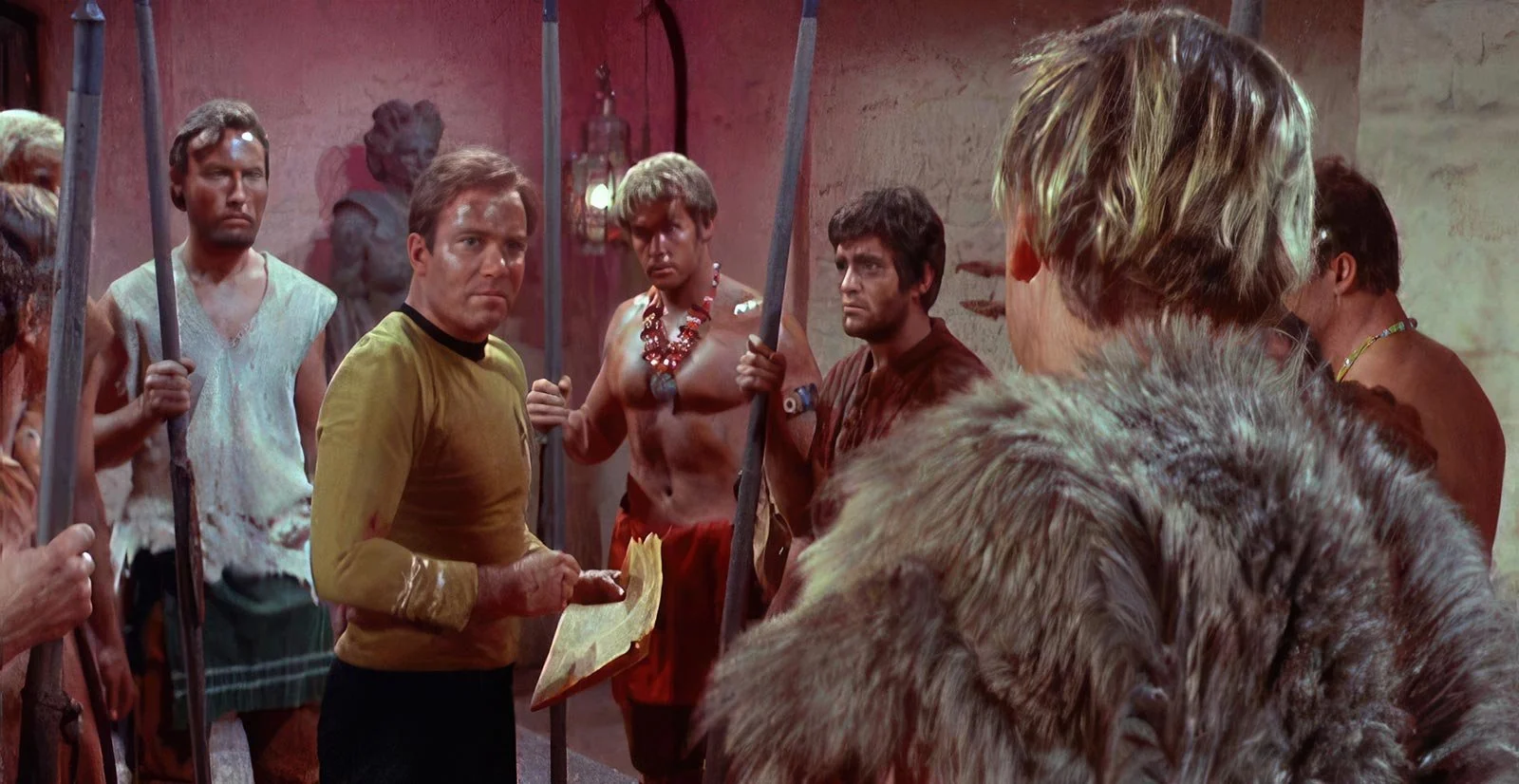
When Captain Kirk recovers consciousness, the situation has deteriorated even further. Captain Tracey has joined the Kohm in a final desperate fight against the Yang. Despite the assistance offered by Captain Tracey’s phasers, the Yang have prevailed in defeating the Kohm despite horrific losses. As Captain Kirk looks on, the victorious Yang march in and Kirk recognizes his former cell mate, the Yang barbarian. The barbarian introduces himself as Cloud Williams, chief of the Yang nation. With great ceremony, Yang warriors stand at attention and troop in their battle standard, a tattered and torn US flag.
As he often does, Spock is at hand to keep the plot on track. There is, apparently, a theory that suggests distant planets with no contact may still develop along the same lines. It seems Omega IV also saw rise to a country exactly like the United States of America, but with a dramatic difference. On Omega IV, the Cold War between the United States and its Communist enemies took a different turn. Global biological war broke out between the two sides and the Yang or “Yankees” were defeated. The Kohm or Communists prevailed, but human civilization on the planet was reduced to the level of the Dark Ages where primitive tribes warred for supremacy. The Yang have essentially become Indians, the original, “Native Americans.”
It turns out this war also explains the “secret” of immortality. An unintended consequence of global biological warfare was that only the healthiest human beings survived. These survivors have such a robust physique that they can live for centuries. However, as Doctor McCoy points out, global biological warfare is a big price to pay for improving longevity.
As the Stars and Stripes are paraded, Chief Cloud Williams faces the flag and intones the words of a sacred Yang rite. To the astonishment of all, Captain Kirk joins him in reciting the ancient words which he recognizes as a garbled memory of the Pledge of Allegiance to the flag.
The Yang are naturally astonished, but Captain Tracey, now a prisoner of the Yang, turns out to be a poor looser. He charges Captain Kirk with witchcraft, offering this as another explanation for why Kirk recognizes the Yang “holy words.” The Yang have also preserved a form of the Bible and Tracey points out that Spock closely resembles the “evil one” depicted in the Yang holy book. Playing on the Yang’s rather primitive religious beliefs, Captain Tracey suggests that the Yang kill Spock and force Captain Kirk to speak the truth.
Chief Cloud Williams is concerned, so he puts Captain Kirk to another test by reciting the words of the Yang’s “holy of holies,” the “Eed Plebnista.” Although the words seem familiar to Kirk, he is unable to make the connection. Another way must be found to determine the truth and the Yang settle on trial by combat. Captain Tracey and Captain Kirk are made to join hands and their left arms are then tightly bound. A knife is placed in the arena and the two are then ordered to fight to the death. It makes good sense to the Yang for, as their Holy book says, “good is stronger than evil.”
Captain Kirk wins the fight and in keeping with the morality of the “Greatest Generation,” he spares Captain Tracey’s life. Meanwhile, Spock has used his mental powers to compel Chief Cloud’s mate to pick up one of the Enterprise’s communicators and summon the ship’s crew which immediately beams down to the rescue.
By this time, Captain Kirk recognizes the words of the Yang’s most holy talisman, the “Ee’d Plebnista.” Ignoring the protests of the Yang High Priest, he takes the document out and reveals it to be none other than the US Constitution. Holding aloft the eighteenth-century manuscript, Kirk points out how the phrase, “We the People” is written in “tall” words and relates how he and his crew have learned that different people from different worlds have their own “high Holy Words,” just as the Yang do. However, Kirk maintains, no “high holy words” compare with the majesty of the US Constitution. In his best high dramatic style, Kirk recites the preamble of the US Constitution:
We, the people of the United States, in order to form a more perfect Union,
establish justice, insure domestic tranquility, provide for the common defense,
promote the general welfare, and secure the blessings of liberty to ourselves and
to our posterity, do ordain and establish this Constitution of the United States.The Yang, Kirk maintains, have forgotten the meaning of the document they revere so highly. Now, in their moment of victory, they must make the Constitution live again by ensuring its promise of justice to all people, including the defeated Kohm.
If the Yang are amazed at Kirk’s knowledge, they are aghast at the suggestion that freedom and equality must apply to the Kohm who, as Chief Cloud insists, are only for killing. However, Captain Kirk is adamant that if the Constitution is to be of any meaning, it must apply to all the people. Chief Cloud has his doubts, but he solemnly promises that the words of the WE THE PEOPLE will be obeyed. On that positive note, the Enterprise crew departs, leaving the Yang to “rediscover the true meaning of their history.”