
The City on the Edge of Forever
Season 1, Episode 28
Summary
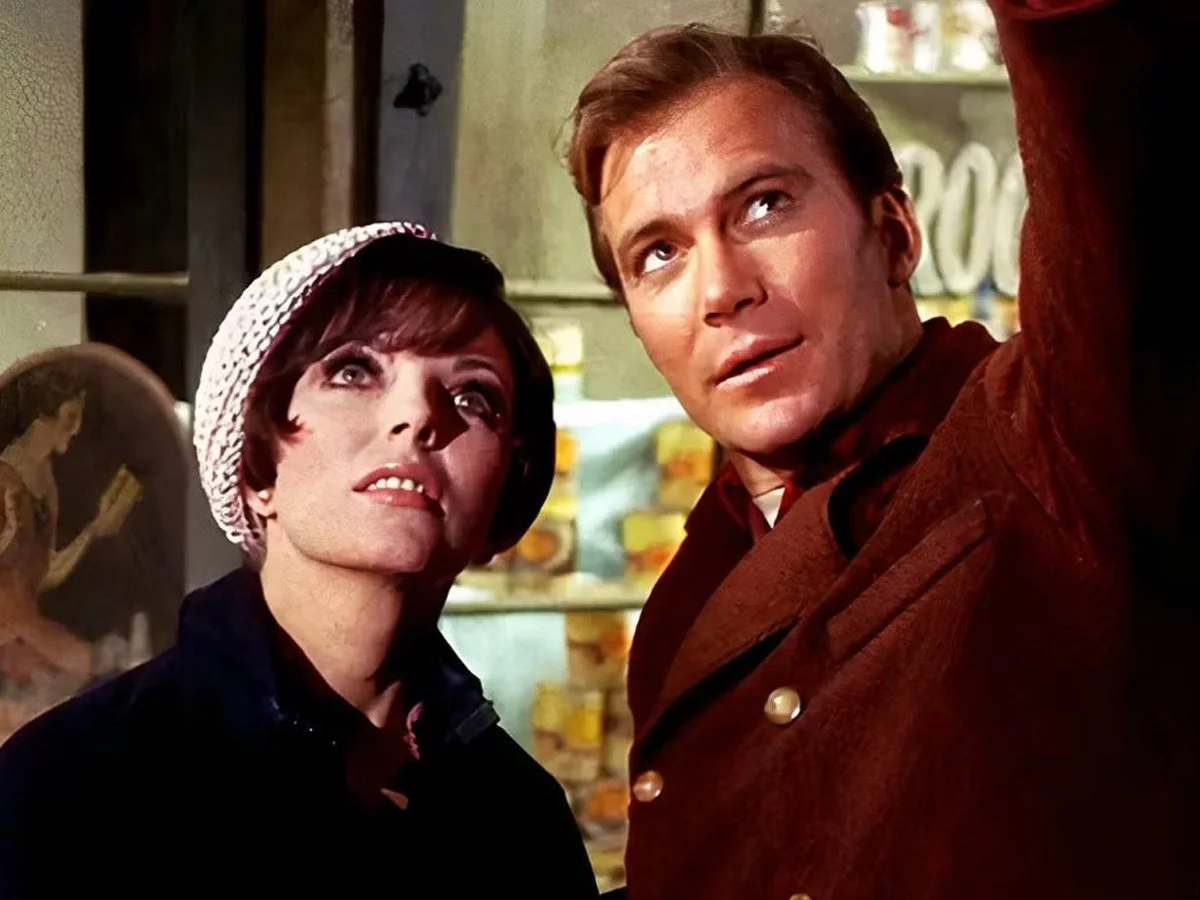
When a tragic accident sends Dr. McCoy into the past and threatens to erase the future, Captain Kirk and Spock follow him to Depression-era America to repair the timeline. There, Kirk falls in love with Edith Keeler, a woman whose compassion and vision for peace are undeniable—but whose survival would lead to global catastrophe. Forced to choose between personal happiness and responsibility to humanity, Kirk allows Edith to die, confronting viewers with the painful reality that doing the right thing can demand profound personal sacrifice.
How to Watch
Streaming: Pluto TV (free), Paramount+, Amazon Prime, Apple TV, YouTube (Primetime Subscription), and Fandango.
Online Viewing: Pluto TV Link
Prompts: History
-
The “Great Man Theory of history” is one those interesting cases in history where a defining idea can be clearly linked to the work of a specific individual. In this case, credit is almost universally given to the 19th century Scottish philosopher Thomas Carlyle who argued succinctly that “history is but the biography of great men.” It was a powerfully formative idea, encouraging as sit did the study of biography of leading figures and the powerful idea that ordinary people could shape and mold their characters following the example of the “great men” of the past.
Herbert Spencer, a contemporary of Carlyle’s was the most prominent critic of the theory advocating what became the opposing point of view that people, even the great leaders, were simply the products of their environment and experience. Although defenders of Carlyle were quick to point out that the essence of the argument was the great leaders were the decisive factor, not the only element worthy of consideration, faith in the “Great Man” theory was shaken. However, the idea still held a powerful grip on the imagination of 1960’s America as the show’s premise is that killing Edith Keeler is the only way to prevent the global pacifist movement that will give Nazi Germany the final and critical advantage.
-
One of the earliest and the most famous groups of American pacifists were the Quakers or more properly, the “Society of Friends.” Originating in 17th century England, the “Friends” resolutely refused to take part in war, even wars that might have been viewed as defensive or otherwise justified response to aggression. Their attitude against violence as well as their refusal to attend the established church or show the normal deference due to their social betters earned them considerable unfavorable attention. Distinguished by plain dress which showed their disregard for earthly vanities and their habit of addressing to friends and strangers alike with the informal “thee” and “thou,” the Quakers were among a variety of religious groups to seek a new beginning in Colonial America. During the 18th century and into the 19th, they were influential in many east coast cities especially Philadelphia which was founded by William Penn who gave his name to what would be the state of Philadelphia.
A second group notable, even notorious, for its pacifist convictions is the Jehovah’s Witnesses, originally known as the Watch Tower Society. Originating in the late 19th century from a Bible study group under the leadership of a Reverend Charles Russel, the group attracted considerable unfavorable attention for its unorthodox beliefs including rejection of the cross as the proper Christian symbol and the view that neither Christmas nor birthdays should be celebrated as both were essentially pagan rituals. Adamant in their conviction that believers should only render loyalty to God, Jehovah’s Witnesses would also reject such civic rituals as saluting the flag, reciting the Pledge of Allegiance or even voting in elections, all actions seen as contrary to the command to worship God alone. Heavily persecuted during World War II, “Witnesses” were harassed, beaten and confined in internment camps along with other “undesirables” such as Japanese Americans. Yet the legal cases brought by and against the Jehovah’s Witnesses would ultimately expand the scope of personal liberties in the US and make the point that even children had the option of participating or not in civic ceremonies such as the Pledge of Allegiance.
-
Eleanor Roosevelt was the wife of Franklin D. Roosevelt, the longest serving Chief Executive in US history. Distantly related to Franklin and with the same last name, the couple were married for some time before FDR contracted the polio which would largely confine him to a wheel chair for the rest of his life. Because of her husband’s physical disability and her own considerable political acumen, Eleanor became a sort of surrogate president, a novel and highly unconventional role for a US First Lady at the time. A longtime advocate for civil rights, Eleanor also played a key if unsuccessful role in encouraging the US to be more active in providing sanctuary for Jewish refugees fleeing Nazi persecution. After her husband’s death in 1945, Eleanor continued to be active in a variety of public causes, continuing her work for improved race relations, advocating for women and becoming an ardent champion for the United Nations to where she served as US ambassador.
For many years, Eleanor Roosevelt was routinely ranked as one of the ten most influential women of the world. Her prominence and the widespread respect she received for her work in the public arena may well have helped inspire the creation of the fictional Edith Keeler, a woman who shaped national, even international events, albeit in the wrong direction!
-
Whatever else may have been said about them, we must always and admit the creators of Star Trek were good students of history, always willing to take a lesson from the past. A good model for the character of Edith Keeler was the American activist, feminist and founding mother of social work, Jane Adams. Born in 1860 to a well-to-do American family, Jane became interested in what was known as the settlement movement, an English enterprise to establish neighborhood shelters to serve the poor and those in need. After careful study of the English examples Jane, in conjunction with her partner and college friend Ellen Start established the Hull House in Chicago in 1889. Far more than a food kitchen like the one operated by Edith Keeler, the Hull house was also a working laboratory exploring and implementing new ideas on how to deal with the ever-growing problems of the urban poor in Industrial Age America. A tireless worker who tackled issues from fund raising to the ins and outs of garbage collection, Jane was awarded various honorary degrees and, in 1931, four years before her death, was awarded the Nobel Peace prize.
Although she was, of course, once young, few would have considered Jane Adam to be especially freedom nor was she ever one to be bewitched by someone as dashing, and perhaps as shallow, as the gallant Captain Kirk. None the less for a writer of imagination, it is not perhaps too much to take a national figure like Jane Adams and cast her as the young and idealistic Edith Keeler.
-
Because writing is a slow, laborious process in which every word is weighed, counted and measured, small choices can be significant. Although Edith Keeler is a fictional character, there was a historic figure with a name oddly similar, Edith Cavell. Born in 1865, Edith Cavell became a nurse, inspired to that line of the work by the care she delivered to her father after a serious illness. Professionally trained, Edith worked a several British hospitals before accepting in overseas position in Belgium in 1907. An energetic worker and a strong leader, Edith worked tirelessly to expand and promote the nursing profession in Europe. Although she was of course a British citizen and Belgium was ground zero for the German attack which initiated the First World War, Edith felt no compulsion about returning to her post in Belgium after a brief holiday in England at the onset of the war.
Her workplace now an International Red Cross Hospital, Edith worked to deliver quality nursing care to all her patients regardless of the uniform they wore. However, it seemed she also had a sense of duty as a patriotic citizen of the British Empire because it seems probable she became involved in secret operations to return British and French soldiers to their units rather than turn them over to the German authorities who now occupied Belgium. Arrested in 1915 and accused of giving aid and comfort to the enemy, Edith was executed by firing squad in October 1915.
Although the German authorities paid close attention to what they saw as the legal technicalities, the execution of Edith Cavell was a huge propaganda coup for the British in World War I. Coming as it did soon after what was perceived as the particularly brutal German invasion of neutral Belgium, Cavell’s execution added to the narrative of the Germans as barbarian Huns and invaders, people lacking in ordinary compassion and decency. Rather like the American school teacher and amateur spy Nathan Hale, executed by the British as a spy during the Revolution, Edith became the exemplar of a British citizen, willing to lay down her life for her country.
Prompts: Science and Technology
-
The V-1 was the ancestor of the modern cruise missile. A jet-engine powered drone, that is a pilotless jet aircraft, it was launched in the general direction of the target, dropping to earth and exploding when its fuel supply was exhausted. Relatively cheap to produce, the V-1 could be launched with comparative erase by troops in the field. With a top speed of about 400 miles, the V-1 could be destroyed by convention anti-aircraft fire or by conventional propeller driven war planes.
The V-2 was the world’s first successful intercontinental ballistic missile, so successful that captured V-2’s became the first building block of the US missile and space programs. Driven by a liquid fueled rocket rather than a jet engine, it was at the time impossible to detect of defeat. Fortunately for the Allies, the Germans never developed an effective guidance system for the weapon so it could only be used against area targets, notably the city of London itself.
-
As is quite often the case, writers like Harlan Ellison who wrote the script for this episode had an uncanny sense of issues that would soon dominate the headlines. In this case, it’s likely the actual drug in mind was an anabolic steroid, a synthetic form of the male hormone, testosterone, which had been first synthesized in the laboratory in the 1930s. Although it had many legitimate medical applications, anabolic steroids could be used to stimulate the growth of bone and muscle mass, giving an edge to those engaged in competitive athletics. Especially among athletes, especially adolescents, “roids” were associate with unpredictable moods swings and seemly random fits of aggression. Although these extent and severity of these side effects is still vigorously debate, Dr. McCoy’s temporary fit of insanity was a perfect Hollywood example of the worst-case scenario, guaranteed to scare the daylights out of any 1960’s parent who discovered a son experimenting with anabolic steroids.
-
The “butterfly effect” is the idea that changes, even small changes, can have enormous consequences over the span of time. Although the term owes a good deal of its popularity to a 2004 film by that name, it was actually coined by an American scientist, Edward Lorenz, in 1969. Among the first cutting edge researches to use computers to study weather patterns, Lorenz discovered the weather models he ran produced very different results, even if there were only barely discernable differences in the data that was entered to each model. Although Lorenz was working with mathematical models, Ray Bradbury, one of the leading science fictions writers of all time, had explored a similar phenomenon in his 1952 short story, “A Sound of Thunder” in which the accidental killing of a small insect causes catastrophic change for a party of time travelers.
Prompts: Religion and Philosophy
-
In our present and perhaps more jaded times we are often asked to confront unpleasant truths, that many of our important leaders during the Revolution were slave owners, that more than a few of our Presidents were not true and faithful husbands. This idea of imperfection has even extended to our fictional heroes so we are not that shocked when Batman drops duly deserving villains into vats of acid. But it was different in the 1960’s so Captain Kirk’s deliberate, premediated action in permitting the death of Edith Keeler is quite striking. Certainly, there was nothing wrong with killing a truly dangerous alien but allowing the death of an innocent and truly inspirational woman? Actually, Kirk is acting along the lines of a school of philosophy known as “Utilitarianism,” which at the most basic level argues, as Francis Hutcheson wrote in 1725, the “best action is the one that procures the greatest happiness for the greatest number.” Acting by this standard, it is the Captain’s clear duty to give up the love of his life (at least for that week!) in order to prevent the world domination by Nazi Germany. Although it is a difficult choice to make, it is made somewhat easier because in this particular scenario, the choice is as stark as it could possibly be, one Star Ship commander’s personal feelings against the future of the world.
Prompts: Literature
-
Although the term “Judeo-Christians” dates back to 1820’s American, it was originally narrowly defined and only used to refer to either Jews who had converted to Christianity or Christian churches which kept or followed customs seen as representative of Judaism. Credit for broadening the term to represent a common ethical and moral approach common to both Jews and Christians is probably due to the writer, George Orwell, who used the term in that sense in a 1939 essay. The late 1930’s was a time which saw an intense persecution of Jews, notably in NAZI Germany but also, albeit less overtly in the United States and other Western countries. In response to the violence, some Christian groups made conscious efforts to narrow the divisiveness and partnerships were formed between Catholic priests, Protestant Ministers and Jewish Rabbi’s.
The term did not resonate especially well with American Jews, especially in the period after World War II where the establishment of Israel led to increased emphasis on Jewish identify and distinctness. None the less as far as Hollywood was concerned, there was some common ground which included a generalized idea of an all-powerful, all-knowing and all-loving God, a tradition of public prayer albeit using texts acceptable to Protestants, Catholics and Jews alike and a place of public reverence for the Bible, a book of writings which included the Five Books of the Jewish Torah.As Christianity was the dominant religious force, Christmas was also celebrated, a convenient choice as it not only had long-standing pagan roots but also played a key role in American consumer culture. Helpful to the key role given to Christmas as a cultural touchstone was a slow, steady but most unconscious process of recasting it in secular terms. Santa Claus, a best a minor Christian saint, became the central figure, traveling the country in his reindeer pulled sled, the imaginative creation of an Anglican minister.
-
Although we learn little about Lt. Nyota Uhura in the series, her very existence as an officer on the Enterprise was a bold move for its time. Progressive for his time, Gene Roddenberry originally envisioned a woman as the ship’s executive officer but this was more than the Hollywood producers were prepared to take on. However, the ground work was laid in the character of Uhura whose name derives from “uhuru,” a Swahili word meaning “freedom.” Clearly bold and talented, Uhura could well have admired Keeler’s leadership skills but she might have taken issue with Keeler’s affection for Captain Kirk. Then too as a South African woman, Uhura might have had some issues with pacifism as a response to oppression. But it’s a matter for debate. We do know that when Nichelle Nichols, the actress who played Uhura, debated leaving the series, it was Dr. Martin Luther King himself who helped persuade her to continue with the series.
Additional Reading
-
If You Love Someone, kill them???
By Star Trek standards, “The City on the Edge of Forever” is fairly straight forward in that there are no sub-plots or competing story lines to distract our attention. At the core, this is a love story between Captain Kirk and his romantic interest of the moment, Edith Keeler, a young social worker trying to bring relief to the down and out during the Great Depression. However, although it’s a love story, it’s also a tragedy and in that regard, a tragedy with a rather unusual plot twist. In a contemporary love story, we might accept that Captain Kirk will lose the one he loves to some deadly disease or untimely accident and we might even permit the idea that he will let his love go, allowing her to choose someone else, perhaps even a better man. However, we are not quite prepared for a story in which the Captain himself will be the direct cause of his love’s death. There will, of course, be a terrible and tragic accident but rather than saving Edith from death, Kirk will actually intervene to prevent his best friend from saving her. And he will do this not because of some hidden sin or flaw within the character of Edith Keeler but because the reverse is true. Edith Keeler is a pure and simple soul who left unchecked will do the right thing at exactly the wrong time.
A Time For War And A Time For Peace
Although the founders of the American republic took great pains to separate “church” organized religion, from “the state,” the majority of immigrants were in fact from Christian European countries and of these, it was the Protestants who quickly gained the upper hand. So complete was the Protestant domination of the political and economic landscape that later historians would coin the term WASP, an acronym for “white Anglo-Saxon Protestants,” to define the American ruling class. And although we celebrate the United States as the land of opportunity, it is none the less true that only two presidents, John Kennedy and Barack Obama, were not members of this ruling elite. Over the course of the 19th century, successive waves of immigration added diversity to national character, Irish Catholic immigrants fleeing the Potato Famine in the early 19th century were followed by Catholic immigrants from Central and Eastern Europe. The late 19th century saw an influx of Jewish settlers, initially from what was then the German Empire and later still, immigrants came from Eastern Europe, notably Russia and Poland. The result of the amalgamation of these disparate groups each with distinct view points and perspectives was a predominant cultural mindset later shorthanded as the “Judeo Christian tradition” –a common ground on which Protestants, Catholics and Jews found general agreement. This mindset found many expressions—the adoption of the US motto, “in God we trust” and the editing of the original text of the Pledge of Allegiance to make clear that the US was not only “one nation” as stated in the original text by George Bellamy, but “one nation, under God.”
For well over a century, American school children would recite the Pledge of Allegiance, join together in the “Lord’s Prayer” and celebrate the birth of Jesus in the annual December Christmas pageant. Not surprising the Bible, especially what Christians called the Old Testament, became the common text, shared as it was by Catholics, Protestants and Jews alike. Whether they could quote the exact chapter and version with any precision, almost all Americans were familiar with these lines from the third chapter of the Book of Ecclesiastes:
To everything there is a time
A time for peace and a time for war
A time for building and a time for tearing down
A time for every purpose under HeavenIndeed, this particular quotation from the Hebrew scripture was so popular, so much a part of the cultural mindset it became the text of a 1965 hit song by a folk-rock group called “The Byrd’s” with the catchy title, “Turn, Turn” and lyrics that affirmed the widely accepted view that there was “a time to every purpose under heaven,” even and perhaps shockingly from our perspective, “a time of war, a time of peace.
The idea that there were times when war was not only necessary but the morally correct course of action was a bedrock element in the mindset of the WW II generation. The rise of Adolph Hitler and the growth of the National Socialist or “NAZI” movement in Germany was seen not only as proof that evil was real and walked the earth but that sometimes the only possible way to counter evil was to take up arms against it. It should come as no surprise that this view of history as a struggle between good and evil, right and wrong was quickly applied to the Cold War with the US cast in the role as the defenders of democracy and freedom while the Soviet Union was, obviously on the side of tyranny and oppression. The nearly decade long ordeal of the Vietnam War would strain this point of view to the breaking point and the brutal realities imposed by a guerrilla war in the jungles of Southeast Asia would cause many Americans to wonder if it was indeed possible to tell “good guys” from “bad guys,”
The Vietnam War was well underway when this episode was written but in the early 1960’s, the fighting was still very much in the background and nothing had happened—yet—which would challenge the idea that there were times when war was not only necessary but the morally correct response to aggression. And there was another factor from the World War II experience which added a sense of urgency, the nearly unquestioned premise that “appeasement,” giving in to the demands of an aggressor, was always a recipe for disaster. When Americans reflected on the events which lead to outbreak of World War II—the occupation of the Rhineland by German troops in 1936 the annexation of German speaking parts of Czechoslovakia, the union of German and Austria– it seemed patently obvious that if the US and its war time Allies, notably Britain and France, had taken a firm stance against Nazi German in the early 1930’s, the entire cataclysm might have been avoided completely.
The Promise—and Limits of 1960’s Feminism
Although Star Trek was forward looking and progressive by the standards of its day, the series’ views on women are very much of the period and significantly different from many we hold today. Indeed, the original series is quite striking in this regard because we can see such a sharp contrast between the ideals of gender equality which the series presents and the behavior of the characters, indeed the creators and writers, who were very much, men of their time.
In this episode Captain Kirk’s love interest is Edith Keeler, a young woman who has founded the 21st. Street Mission in New York City to minister to the hungry and the downtrodden of the United States in the depths of the Depression. In the altered time line which Captain Kirk and Spock must correct, Edith Keeler will go on from her work on the 21st Street Mission to become the leader of a world peace movement, a person of such importance that she will sit down to council the President of the United States himself. But although the story makes her out to be a person of enormous will and considerably political and social acumen, she is simply portrayed as another pretty young woman, star-struck by Captain Kirk’s looks and charm. While the creators of Star Trek were mentally prepared to accept the idea of a woman as the leader of a global movement, they had a hard time separating woman as objects of romantic interest from what we could now thing of as women as professionals, colleagues and team members with equal standing in the work place. Interestingly enough, the writers, actors, and directors were aware of the work of Eleanor Roosevelt, the widow of the late President Roosevelt who would be one of the first women to establish herself as an important political figure in her own right. But as accomplished as she was, Eleanor was an older woman, a wife and a mother—and so it was far easier for this generation to accept her later prominence and influence in the political world.
Only decades after the story was written and broadcast did there appear a young woman on the world stage who embodied the beauty, innocence and lofty ideals of the fictional Edith Keeler. This person was Diana, Princess of Wales who became the unhappy bride of Charles, Prince of Wales. To the dismay if not the surprise of palace insiders, Diana would prove to be woefully unprepared to fulfill the conventional ideas of a fairy tale princess. Yet even her critics would have to admit that even as her marriage to Prince Charles was crashing down in reasons, Diana would go on to become a charismatic figure in her own right, tackling issues from land mines to the proper position of women in society. And like the fictional Edith Keeler, Princess Diana would die tragically in a car accident, forever young and beautiful in the public mind. It’s interesting to speculate how the story of Diana might have played out had that bit of history, history as yet decades in the future, been available to the writers of the Star Trek Saga.
History and the “Great Man” (or Woman?)
A persistent but now somewhat dated argument in history is the idea of the “great man,” the theory that the course of human events is shaped by the force, drive and character of specific individuals. This idea had real resonance in the 1960’s because at the time it seemed self-evident that the United States had become the country it was because of the work of its national heroes, most notably George Washington and Abraham Lincoln. For nearly a century from the late 1800’s through the middle of the twentieth century, classrooms throughout the country would display flanking portraits of George Washington and Abraham Lincoln, respectively the founder and defender of the American Republic. Just two years before this episode aired, President John Kennedy had been assassinated, a leader who in the popular imagination was a young idealist, not too dissimilar from the bright-eyed Edith Keeler. In keeping with this tradition, Edith Keeler is portrayed in keeping with this “great man” tradition except that she is, obviously and strikingly, a woman!
Now as we near the end of the first quarter of the 21st century, most of us are inclined to take a more jaded, less idealist view of the way in which history unfolds. On balance, many would take the position that events are often driven by the political, economic and social circumstances of the times than by the character and drive of specific individuals. Yet as the rather improbable election of President Trump clearly suggests, there are times when one individual really does seem to make a difference. And while there is likely to be now and in the future spirited discussion as to the legacy of Donald Trump, few can doubt that his presidency, shaped by his own distinctive style and approach, had a profound impact on the course of US history and politics.
-
A Nightmare Scenario: The German V-2 Rocket armed with a nuclear warhead
A key concept to grasp right at the outset is the intensity and fervor with which the “Greatest Generation” seized on the “lessons learned” from World War II, a global cataclysm which was for them closer in time than “9-11,” the attack on the World Trade Towers in September 2001 is to us. And, as veterans of the war like Gene Roddenberry reviewed the then recent past, it seemed in hindsight like the ultimate US and Allied success had been a very near thing and that if the course of history, that is the timeline, had only been slightly altered, it would have been Germany rather than the US which developed atomic weapons. This was terrifying prospect to contemplate because Nazi German was far ahead of the Allies in rocket technology, building and later fielding both the V-1 “buzz bomb,” the direct ancestor of the modern cruise missile, and the V-2, the world’s first successful long-range ballistic missile. Later investigation would show the German effort to develop nuclear weapons was rather modest in scope, never approaching the size and complexity of the US program known to history as the “Manhattan Project. None the less the prospect of a Nazi regime armed both with atomic weapons and the ballistic missiles for delivering them to their targets at supersonic speeds was enough to evoke a collective shudder and the sense that if things had only gone just a bit differently, it would have been the Axis and not the Allies who shaped the post-war world.
But if Nazi Germany’s failure to develop a nuclear weapon might have pointed to a technical and scientific superiority on the part of the Allies there were other twists and turns which might have produced a very different end to the conflict. While the invasion of Poland in the fall of 1939 marked the begging of World War II in Europe, the US would not enter the conflict until December 1941, a full two years later. Nor was it a foregone conclusion that the Japanese attack on Pearl Harbor would automatically involve the US in a global conflict. Some of the credit, if credit is the right term, went to Adolph Hitler who declared war on the United States in the immediate aftermath of the Japanese strike. If the German Chancellor had been a bit more inclined to carefully consider his actions, less convinced in his own invincibility and pre-ordained role in history, he might have hesitated, waiting to see if a US-Japanese war would ultimately lead America in the conflict on the side of the British. And if the America had only gone to war with the Japanese Army—and that was the only declaration of war requested by President Roosevelt at the time—would the absence of American military aid first in terms of material and later in terms of actual boots on the ground have made a critical difference?
The Power of Pacifism
But there was another factor quite apart from possible strategic blunders on the part of the German Chancellor. Largely overlooked in the condensed story of World War II presented in a typical high school textbook were two powerful currents of popular thought, pacifism and isolationism.
Pacifism, the belief that armed resistance, even to aggression, is always wrong, was a viewpoint strongly held by some of the very first European settlers, most notably the Society of Friends popularly known as the Quakers. Viewed as radicals by many of their 18th century peers, Quakers refused to recognize outward signs of social distinction, insisted on referring to everyone, even their presumed superiors, with the informal “thee” and “thou” rather than the more correct, “you” and “your” and adamantly refused to take part in armed conflicts. And although the Quakers were one of the most prominent of American pacifist groups, they were by no means the only ones.
Another pacifist group very much in the headlines during WW II were the Jehovah’s Witnesses, first known as the “Watch Tower Society.” Originating in the 19th century from a Bible study movement lead by the Reverend Charles Russel, believers quickly attracted attention by their rejection of the cross as a sign of the Christian faith and by an adamant insistence that the end times and the last judgment were close at hand based on their own calculations of the timeline laid out in the Book of Revelation. While believer’s refusal to accept blood transfusions may have struck many as simply odd, other ideas such as not celebrating birthdays or Christmas on the grounds both were essentially pagan rituals, were less well tolerated.
By the 1930’s, the group, now known officially as “Jehovah’s Witnesses” came into even more notoriety when members were instructed to refuse to salute the flag, recite the Pledge of Allegiance or take part in military service including the alternative service offered to conscientious objectors. Not surprisingly, persecution of Jehovah’s Witnesses” during WW II intensified and in 1940 even the Supreme Court upheld the decision of schools to expel children for refusing to salute the flag or recite the pledge. Eventually law suits brought buy or against the Jehovah’s Witnesses would do much to redefine personal freedom in the United States.
All of this was comparatively recent history when “City on the Edge of Forever” was produced, powerful testament that if the right leader had emerged, a global pacifist movement could have arisen—and given Nazi German the lead time it needed to develop nuclear weapons, the final and terrifying finishing touch to the V-2 intercontinental missile.
-
The Enterprise is in orbit around an earth-like planet when it detects some sort of “anomaly” which Spock, the science officer and ship’s second in command, mysteriously describes as “ripples in time.” The turbulence intensifies and the navigator, Lt Sulu, is injured when he is hurled against his console. The injury prompts a medical call from Dr. McCoy who administers a shot of “cordrazine,” a drug unique to Star Trek but which appears to be some form of steroid. The ship again encounters severe turbulence and, Dr. McCoy accidentally injects himself with the full dose of the drug. Almost immediately McCoy begins to suffer from what latter generations of Americans would recognize as “roid rage,” a fit of irrational anger and subsequent loss of control prompted by an over-dose of steroids which would in later years be considered a particular affliction of weight lifters and other athletes seeking to increase muscle mass. A chase through the Enterprise ensues but the crafty though clearly insane Dr. McCoy overpowers the guards in the transporter room and beams down to the planet’s surface.
Of course, there is nothing for the gallant captain to do but beam down to the planet’s surface accompanied by a full landing party which includes engineer “Scotty,” and Lt. Uhura, the communications officer as well as Spock and, of course, Dr. McCoy. Down on the planet’s surface, the landing party immediately encounters a large stone ring which Spock announces is the source of the temporal disturbance. Fortunately, this particular edifice is capable of speaking for itself and proceeds to inform Kirk and his crew that it is the “Guardian of Forever,” and has the power to transport the crew to any place in the past history of the planet. The potential impact of this knowledge must be considerable for the stunned landing part again loses control of Dr. McCoy who takes advantage of their inattention, bolts from his erstwhile shipmates, and leaps through the ring and into the past.
Loosing Dr. McCoy is bad enough but far worse is ahead as the “Guardian” announces that by his actions, actions as yet a complete mystery to the crew, Dr. McCoy has somehow altered the time-line leaving the crew stranded, without a past, without a future, in essence almost without an existence. Spock, never one to lose his focus, announces to Captain Kirk that not only has he been recording the images provided by the “Guardian” but he is able to slow down the images and so identify the approximate time at which Dr. McCoy leapt through the portal. With this and little else to go on, Kirk decides the best course of action is for he and Spock to make the leap into the past and try to correct whatever Dr. McCoy has done to the time line. The “Guardian” for reasons of its own is willing, the images are replayed and, never given to much hesitation, Kirk and Spock leap through the portal and the chase is on.
On the other side of the portal, Spock and the Captain find themselves in the year 1930 at the depth of the Depression, in the heart of New York City and within sight of the Brooklyn Bridge. Finding that both their Star fleet uniforms and Spock’s Vulcan ears make them all too conspicuous, the pair decide to steal some clothes but are promptly accosted by a New York cop. In a valiant attempt to live up to his previous boast that he can talk his way out of anything, Kirk attempts to explain Spock’s appearance by claiming that not only is he Chinese but that he suffered a childhood injury from a “rice picker” and was only saved by the intervention of a gifted plastic surgeon from an American mission. Of course, the explanation means little to the officer and Spock is forced to employ his famous nerve pinch. The two escape to a nearby basement where, while changing clothes, they attract the attention of an attractive young lady who introduces herself as Edith Keeler, the social worker who directs the “21st Street Mission.” A trusting individual if ever there was one, she promptly hires Captain Kirk and Spock to do some work around the mission.
The challenge, of course, is to intercept Dr. McCoy but given the search could possibly include all of history and the universe, it’s a pretty tall order. However, Spock has both a theory and a practical idea in mind. His theory is that the flow of time is similar to the flow of a river and if this is the case, it’s likely that if the current brought Kirk and McCoy to the 21st Street Mission in Depression America circa 1930, its quite likely to do the same to Dr. McCoy. While they wait for McCoy to arrive, Spock accepts the challenge Captain Kirk throws down, to build some sort of computer which will allow him to access the images on the tricorder and pinpoint the time of Dr. McCoy’s arrival. Armed with this knowledge, it should be a small matter for Kirk and Spock to intervene and prevent the doctor from doing whatever he did to disrupt the time line.
This certainly give the Captain food for thought so he and Spock make their way to the mission cafeteria where they get not only something to eat but an after-dinner pep talk by Edith Keeler. An optimist as well as a social worker, Edith entertains the down and out with an inspired vision of the future a future where disease and poverty have been eliminated and where intergalactic space travel is common place. Needless to say, such talk has little effect on the down and out of Depression America but it certainly strikes a chord with Captain Kirk and Spock who, as visitors from the future have a pretty good sense of how things are supposed to turn out. Romantic interests between the captain and the female guest start are a standard plot device in Star Trek so we are hardly surprised when a friendship quickly develops between Kirk and Edith Keeler, a friendship which we know from the first will not end well.
Apparently, Edith Keeler has a heart for cute crooks and she hires Spock and the Captain to do some work on the furnace. It’s a lucky break for our heroes as it gives them an opportunity to steal some burglar’s tools and for Spock to thus make faster progress in “Computer Construction 101.” Given the materials with which he has to work and in culture which he colorfully describes as “bear skins and stone knives,” it’s one step forward and three back. But before his apparatus goes up in smoke, Spock discovers that there are two possible timelines, two paths to destiny which await the diminutive Edith. In the one path, Edith will in six years become the leader of a world-wide peace movement, a celebrity who will sit at the right hand of kings and presidents. But, hopeful as this vision is, this is the path to disaster, the ultimate example of the “right idea at the wrong time.” Guided by Edith Keeler’s vision of world peace, the US will further delay its entry into World War II and as a result Nazi German will gain just the time it needs to develop atomic weapons, weapons which it will use in combination with the V-2 rocket to gain world domination. If this is to be avoided, that another time line must prevail, a time line which dictates that Edith Keeler must be killed in some sort of accident this very year. Although he has a weakness for a well-turned ankle and considerable skill in charming women, Captain Kirk takes this as more than a bit of a set-back confessing to Spock that he has, predictably, fallen in love with Edith.
Fortunately for the story line, Spock’s theory about eddies in time and currents proves to be correct and Dr. McCoy now arrives to join Captain Kirk and Spock in Depression New York. Still recovering from the effects of his “roid rage,” Dr. McCoy correctly deduces the time and place of his situation and has the further good luck to attract the personal attention of Edith Keeler who completes the work of bringing him back to health, all the while entertaining him with stories of her interesting new “friends” whom she suspects are somehow connected to Dr. McCoy. Understandably unsettled by his recent experience, Dr. McCoy is a bit slow to realize that the interesting new friends who have so fascinated Edith Keeler are his very own shipmates from the Enterprise.
The clock is running both for Edith and the episode as events move quickly to the culminating point. However, just to be sure we understand the enormity of the choice Captain Kirk must make, we are granted a final affectionate scene between Captain and Edith. At the close of a romantic evening, Edith stumbles on the stairs and acting almost from reflex, Captain Kirk catches and steadies her. This immediately earns him a stern rebuke from Spock who repeats his point that if the time line is to be corrected and the damage undone, Edith Keeler must die.
There is just enough time left for us to see how painful the choice will be for our valiant captain. In very short order, the three crew members are reunited, albeit at opposite ends of a busy street. Temporarily confused by the reunion, Edith Keeler steps into the path of an oncoming truck and it is Captain’s Kirk’s unhappy duty to restrain Dr. McCoy who otherwise would have been just in time to save Edith from death, a death which is necessary to keep peace from breaking out at precisely the wrong time.
Duty is done and the proper timeline restored but this is no time for idle chat. Although many Star Trek episodes feature a brief a post-episode wrap up around the command chair on the bridge, Mr. Spock and Dr. McCoy sparring in an ongoing debate over emotion versus logic, this is not the time and the place. To Dr. McCoy’s heartfelt and searching question, “Jim! Do you know what you have done!” Spock has only one simple and profoundly meaningful response, “He knows, Doctor, he knows.
And as all good writer know, sometimes the less said, the better. Spock, McCoy and the Doctor leap back through the portal, rejoin the landing party and return to the Enterprise. Although Spock, McCoy and the Captain must have quite a story to relate, it will be a story for another time and all Kirk will say at the moment is, “Let’s get the hell out of here.” It’s not always easy to do the right thing but in the simple but admirable morality of the original Star Trek, a good captain will do what has to be done, even at the cost of his own personal happiness.