
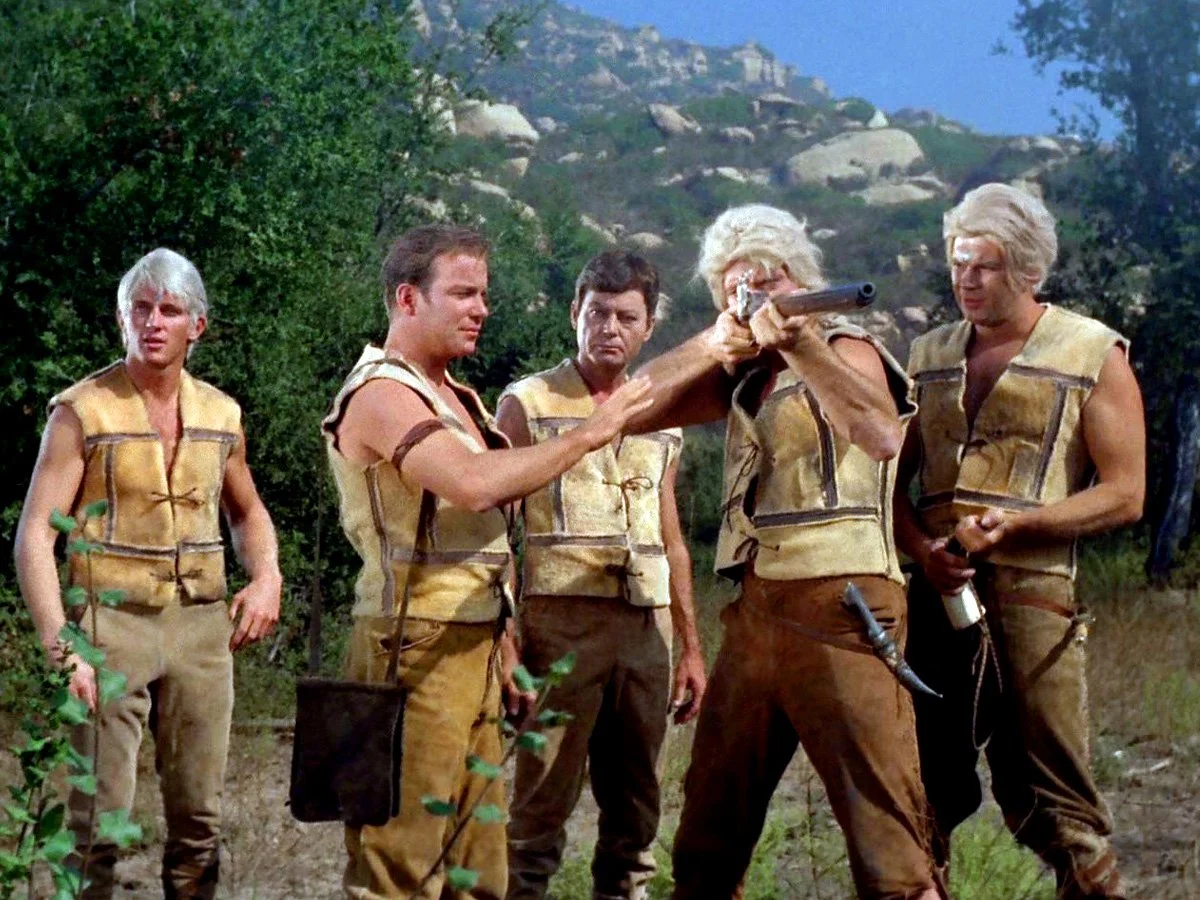
A Private Little War
Season 2, Episode 19
Summary
The Enterprise returns to a planet Captain Kirk once knew as a peaceful Eden, only to discover it has been corrupted by weapons and outside interference from the Klingons. As Kirk uncovers a plot to slowly introduce war and is forced to choose between non-interference and action, the episode confronts questions of responsibility, leadership, and the cost of power. In trying to restore balance by arming both sides, Kirk saves lives—but at the expense of the planet’s innocence—forcing viewers to wrestle with whether good intentions can justify morally troubling choices.
How to Watch
Streaming: Paramount+, Amazon Prime, Apple TV, YouTube (Primetime Subscription), and Fandango.
Online Viewing: https://vimeo.com/81912586
Prompts: History
-
Captain Kirk was referring to the two major regional conflicts in Asia: The Korean War (1950-1953) and the Vietnam War (1950-1973) As the term, “brush war” implies, these conflicts were often compared to wild fires which consumed the shrubs, bushes and other parts of a forest’s undergrowth. Left unchecked, a brush fire could easily develop into a major blaze requiring thousands of firefighters. Dealing with a major fire is much more dangerous and expensive than fighting a small brush fire. However, brush fires are difficult to extinguish completely and require constant effort to control. By referring to Korea and Vietnam as “brush wars,” Kirk is expressing one popular view of the period. “Limited” wars, like Korea and Vietnam were bloody, costly, and often morally ambiguous. However, in an imperfect world, a limited or “brush” war was preferable to a world war between the major powers.
-
In Star Trek, the United Federation of Planets is the United States while the Klingons represent the Soviet Union. In the Cold War, many regional conflicts were rooted in the struggle between the United States and the Soviet Union, each supported by their respective allies. During the Korean War, the United States backed South Korea while Communist China supported North Korea. In the Vietnam War, the United States supported South Vietnam while China and the Soviet Union provided support to North Vietnam. These conflicts were sometimes called “proxy wars” and this episode is a near perfect example. Here we find the “Hill People” taking up the fight on behalf of the Federation while the “Villagers” are supported by the Klingon Empire.
-
In the Vietnam War, the US found military success elusive, despite employing a huge number of troops. With absolute control of the air, US Forces could travel anywhere in Vietnam, almost without opposition. However, at night, the Viet Cong or Vietnamese Communists could attack the American troops, often with deadly results. Because it was difficult to force a decisive battle with the Viet Cong and their North Vietnamese allies, the US decided to employ “Special Forces.” The most well-known of these forces were the “Green Berets,” known for their distinctive headgear. Operating in small teams, the Green Beret had the mission of organizing, training and leading soldiers recruited from the local people. Many of these recruits came from the highlands of Vietnam and Laos. Known collectively as Hmong, these highland people may have been the inspiration for the “Hill People” in “A Private Little War.”
-
For those who believe in a “balance of power,” the best way to preserve stability, if not peace, is to make sure each side has roughly equal military power. Captain Kirk applies this doctrine by supplying the Hill People with flintlocks to “balance” the advantage the “Villagers” received from the Klingons. However, to maintain equilibrium, Captain Kirk’s response must be “proportionate”—the weapons he supplies must be equivalent to those supplied by the Klingons.
-
As a doctor, McCoy knows the human cost of war. When Captain Kirk reminds him of the “Asian Brush Wars,” McCoy points out how they went on for “year after bloody year.” In order to avoid open conflict between the Federation and the Klingon Empire, Captain Kirk is prepared to condemn the Hill People and the Villagers to years, perhaps decades of conflict. Captain Kirk acknowledges the human cost but vociferously insists that this bloody “balance of power” is the only way that both the Hill People and the Villagers will survive.
Prompts: Science and Technology
-
All firearms work by igniting a charge of gunpowder which propels the round. One of the challenges in the development of firearms was improving the method of igniting the charge. The earliest guns were fired by “matches” very similar to the mosquito coils we know today. To fire the weapon, asoldier blew on the edge of the match and then touched it to a powder charge. The next step was to attach the match to a metal device or “hammer” and use a simple lever or “trigger” to cause contact between the match and the powder.
The flintlock was a more complicated but much more effective means of igniting the charge. A charge of gunpowder was placed in a small pan connected to the main charge by a channel or touch hole. The pan was then covered by a metal cover which was itself attached to a vertical piece of metal called a “frizzen.” The hammer was driven by a spring and fitted with a locking device so that it could be held in position. In the jaws of the hammer was a small piece of carefully shaped flint. When the trigger was squeezed, the hammer flew forward, striking the frizzen. The frizzen in turn snapped back, exposing the powder in the priming pan. At the same time, the impact of the flint with the frizzen created a series of sparks, ignitingthe priming charge and firing the weapon.
-
To deal with the poisonous bite of the Mugato, Nona uses a bit of magical root from a “mahko” root. The inspiration for the “makho” root is the mandrake, a member of the nightshade family. Long associated with witchcraft and magic, the mandrake or mandraga was often used in love potions and is even mentioned in the Bible. Part of the reason for the root’s magical associations is its unusual appearance. It is often “bifurcated” or split in two giving it a vague resemblance to the body and legs of a human being. According to medieval legends, the mandrake screamed as it was pulled out of the ground. Fortunately, the script writers did not try to use that detail in the episode, leaving it to find new life in a “Harry Potter” film.
-
At the time this episode was aired, the popular notion of witches was undergoing a radical transition. According to traditional Christian beliefs, witches were women who sold their souls to the devil in exchange for magical powers. Belief in witches was widespread, so much so that an English king, James I, wrote a widely regarded textbook on the subject. In Colonial America, the most notorious example of a “witch hunt” were the Salem witch trials in seventeenth century New England where several people were put to death for witchcraft or sorcery.
By the 1960’s, a very different view of witches was emerging. Some historical researchers suggested the original witches may well have been devotees of earlier, pre-Christian faiths who were naturally seen as dangerous by Christian missionaries. Some of these priests, especially women, may have been experts in the use of natural medicines. Nona is a transitional figure in this cultural redefinition. On the one hand, she is experienced in the use of medicinal plants but she is also a practitioner of “black arts” who uses her powers to influence and control others, especially men.
-
In 1953, Edmund Hillary and Tenzing Norgay, a Nepalese Sherpa, reached the summit of Mount Everest, the highest mountain in the world and the last of the great peaks to be scaled. A remoted and rugged country, Nepal had long been seen by Westerners as a land of mystery and was one of the last inhabited places to be “discovered.” For decades, both before and after World War II, various expeditions climbing in this area heard legends of a mysterious beast called the “yeti” or the “abominable snowman,” an ape-like creature living in the remote peaks of the Himalayas. In the 1960’s, even the scientific community was not yet sure if such a creature actually existed and a few expeditions set out specifically to see if they could identify the creature. Needless to say, no such creature was ever found but the interest led to a popular fascination with a North American version of the Yet, later dubbed “Big Foot.” Like the Lake Ness monster, the “yeti” and “big foot” proved both a boon to the local economy and a well-spring for no end of pseudo documentaries.
Prompts: Religion and Philosophy
-
The story of the Garden of Eden is related in Chapters 2-3 of the Book of Genesis, a part of scripture known to Jews as “the Torah” and to Christians as “the Old Testament.” God plants the Garden of Eden in an area between the Tigris and Euphrates rivers. He fills the Garden with all the plants and animals of creation, finishing his work with Adam, the first man who is created to care for the Garden. Seeing that Adam was lonely, God brought before him all the animals of creation for companionship, but none were suitable. God then created Eve, the first woman, by taking a rib from Adam’s side. Life in the Garden was idyllic for this first couple as everything they needed was provided for them.
-
As related in the Book of Genesis, Eve is tempted to eat of the Tree of the Knowledge of Good and Evil because she is “beguiled” by the serpent, the craftiest of all animals in the Garden. The serpent promises Eve that she eats of the fruit of the forbidden tree, she will have the power of God, knowing good and evil. In “A Private Little War,” Nona is tempted by the superior technological power of the Federation just as Eve was tempted by the serpent. She expects that if Kirk is really a friend to her husband, Tyree, he will make him powerful by giving him weapons to crush his enemies. When Tryree refuses, Nona steals Captain Kirk’s phaser and tries to offer it to the Villagers. Tyree longs to return to the old ways of innocence and only agrees to accept the weapons Kirk offers after Nona’ death. However, in this version of the story, it is Captain Kirk and not Nona who provides the serpents—flintlock rifles.
-
In the ten years which separated the original “Star Trek” from its successor, Star Trek: Next Generation, the thinking which led to the Vietnam War underwent a dramatic revision. In “A Private Little War,” Kirk directly interferes with the planet’s development, justifying his actions as a response to a Klingon provocation. At the time this episode aired, most Americans believed that the North Vietnamese and Viet Cong were armed, supplied and even directed by the Soviet Union and its allies. But after US forces withdrew, the “dominoes” refused to fall and there was no dramatic change in the politics of the region. As time passed, many Americans came to believe that US involvement in Vietnam had been a colossalmistake, an ill-conceived effort to meddle in the affairs of another country.
Additional Reading
-
“Defending the Vietnam War”
Written during the fiercest fighting in Vietnam, “A Private Little War” is a vigorous defense of US foreign policy in Southeast Asia and the US effort in Vietnam. And that makes this episode a challenge for it is hard for us today to support what Captain Kirk and his crew are doing—arming a peace-loving people and dragging them into a galactic struggle between the Federation (the US) and the Klingon Empire (the USSR).
Gene Roddenberry, the creator of Star Trek, served as a bomber pilot in the Pacific during World War II. He believed, as did other members of the “Greatest Generation,” that the war his generation was called on to fight was not just inevitable—it was morally justified. In “A Private Little War,” Captain Kirk is cast as a responsible leader faced with an unpleasant choice. He must convince Tyree, an old friend and avowed pacifist, to take up arms in order to defend himself and the “Hill People” from the “Villagers,” a group with which they were formerly at peace. Whatever course of action Tyree chooses, whether hefights or not, there will be war as the Villagers are now under the control of the nefarious Klingons. The Klingons, of course, represent the Soviet Union as it appeared to the US at the time--ruthless in the pursuit of its objectives and indifferent to human sufferings. In a world where such dangers exist, the best choice may only be the lesser of two evils. Captain Kirk makes that choice. For the “Greatest Generation,” one of the essential lessons from World War II was that “appeasement,” giving in to the demands of an aggressor, was a recipe for disaster. In this episode, Captain Kirk is a willing party to a “proxy war,” one that will bring suffering and death to people whom we once befriended. Yet Kirk believesthe circumstances give him no choice.
“A Balance of Power”
The theory behind a balance of power was that warfare between nations can be avoided or at least contained if the opposing sides each had roughly equal military capabilities. Long a mainstay of foreign policy, the idea become more important during the Cold War, the three-decade struggle between the US and the Soviet Union. Nuclear weapons had become so destructive as to render traditional understanding of “victory” or defeat meaningless. But there was always the fear that one side might be tempted to try a surprise attack. It became an article of faith that showing what could be interpreted as a sign of weakness was risky and would only tempt a “first strike,” a surprise nuclear strike. Hence both the US and the USSR, felt compelled to intervene in any situation which might tip the “balance of power.”
“Proportional Response”
However, implicit in the idea of a balance of power was that the use of force had to limited--an idea called “proportional response.” During the Korean War (1950-53) General Douglas MacArthur’s proposal to use nuclear weapons against Communist China, an ally of North Korea, was one factor that led to his removal from command. Resorting to nuclear weapons, it was felt, would be “disproportionate,” requiring the US to use more military force than was really necessary. Furthermore, and this was a key point, China was now itself a nuclear power. And although the creators of Star Trek confidently predicted that nations would eventually get beyond this awkward and dangerous stage in history, no one, then or now, had quite figured out how.
-
“Special Forces in the Vietnam War”
US involvement in Vietnam began at the end of WW II. The French colonial forces were trying, unsuccessfully, to suppress a communist rebellion in their former colony. The United States supported France in its war against the Viet Minh or Vietnamese Communists, a group later rebranded as the “Viet Cong.” When French troops were defeated by the Vietnamese communists at the battle of Dien Bien Phu in 1954, US forces stepped in. By the time this episode aired, nearly half a million American soldiers were fighting in Vietnam.
Battlefield conditions in Vietnam were challenging, offsetting the US advantage in both troops and conventional weapons. American forces had difficulty locating the Viet Cong and forcing decisive battles. The most common tactic was to patrol the dense jungles of Vietnam and wait for the inevitable ambush. Because conventional forces did not seem to be the answer, the US developed “Special Forces” such as the “Green Berets.” Named for their distinctive green colored berets, these soldiers typically operated in small teams of ten to twelve men. Experienced combat soldiers, “Green Berets” were selected for their ability to learn the local language and culture. Their mission was to organize, train and lead local people in the fight against the enemy. In this episode, Captain Kirk operates as the head of a Special Forces team. And as in Vietnam, Kirk’s challenge is political as well as military—he has to convince Tyree, the local chief, to take up arms.
“Holistic medicine”
Popular interest in “natural” foods and “holistic” medicine began in the 1960’s. All though the movement included many beliefs, one was that Native Americans in particular and indigenous peoples in general understood “natural” remedies perhaps as effective as scientific medicine. One effect of this movement was a redefinition of the idea of who and what was a “witch.” In the traditional Christian view, witches were women who had agreed to serve the Devil in return for magical powers. Now witches came to be seen as medicine women skilled in traditional native cures. Because this was an emerging idea, the character of Nona, Tyree’s wife is decidedly mixed. While her medical skills are powerful, her motives are suspect. She is portrayed as a scheming and manipulative, desperate to get her hands on the powerful weapons Captain Kirk and his crew possess. Her ambition is further tainted by a woeful ignorance of the harmful effects of the power she seeks. She covets superior weapons and the power they bring but fails to understand the destructive forces they will unleash.
Finally, there was growing interest in what was called “mind over body.” Enormous advances in medicineresulted in immunizations against polio and other infectious diseases that were once common. Yet there was growing realization that health and sickness could not be explained in purely chemical terms. Human willpower and emotions clearly played a part in the healing process. One result of this change in thought was increased interest in meditation and other practices that relied on the power of the mind. Spock’s demonstration of Vulcan mental healing powers in this episode reflects the popular interest in practices that would ultimately result in the widespread acceptance of Yoga, Tai Chi and other disciplines.
-
The Enterprise is in orbit over a “class M” planet, one similar to earth. It is a planet Captain Kirk knows very well having visited it seventeen years ago as a new lieutenant in Star Fleet. According to Kirk’s recollection, the place was a “veritable Eden” where the planet’s two groups, the “Hill People” and the “Villagers” lived simple, peaceful lives. Captain Kirk himself became good friends with Tyree, a hunter and rising tribal leader of the Hill People. A small landing party, Spock, Captain Kirk and Doctor McCoy, arrives and is investigating the plant life when three Villagers appear armed with flintlock rifles. Captain Kirk orders an immediate retreat, but Spock is wounded before the transporter can return them to the Enterprise.
Spock’s gunshot wound is only one nasty surprise for the crew of the Enterprise. When the landing party returns to the ship, they discover a Klingon cruiser orbiting the planet. As the Klingons are apparently unaware of the Enterprise’s presence, Captain Kirk decides it is too risky to notify Star Fleet of what may be a serious violation of the treaty between the Federation and the Klingon Empire. In a characteristically cavalier manner, Kirk decides he must personally handle whatever has happened to interfere with the planet’s formerly peaceful character.
Captain Kirk decides to return to the planet and investigate the mysterious appearance of flintlock rifles. As Spock is in intensive care in the ship’s sick bay, the Captain takes Doctor McCoy as his right-hand man. It is a fortunate choice for soon after their return, Kirk is attacked and bitten by a poisonous ape like creature, a mugato, easily the worst-dressed alien in all of Star Trek. From his previous work on the planet, Kirk knows his only choice for survival is to contact his old friend, Tyree and seek the medical knowledge of a Kanutu, one of the local “witch people” or spirit healers.
Tyree is close at hand and a runner sent by McCoy makes him aware of Captain Kirk’s peril. Conveniently, Tyree is now married to a Kanutu woman, Nona, who knows how to treat the deadly bite of the mugato. She and Tyree immediately leave for the cave where Captain Kirk and Doctor McCoy are sheltering, arriving just in time to see McCoy using his phaser to heat a rock. The display of this powerful technology makes quite an impression on Nona, but she concentrates on the task at hand. Using a piece of mahko root and a rather bizarre ritual, she succeeds in extracting the poison from Captain Kirk. Tyree is relieved but concerned, for he believes the healing ritual gives a Kanutu like Nona magical powers over his old friend, Captain Kirk. The immediate crisis past, Captain Kirk interviews Tyree about the dramatic changes in the former Eden. According to Tyree, the flintlocks first appeared just a few years ago and are apparently made in the neighboring village. The decision is made to travel to the village at night and investigate matters further.
In the meantime, an intense debate erupts between Nona, Captain Kirk, and Tyree. Nona is aware that Kirk has access to weapons far superior to those of the Hill people. Because he is or claims to be a friend of Tyree, Kirk could easily make Tyree the most powerful man on the planet. Captain Kirk acknowledges this could be true, but warns Nona that such technology is as dangerous as it is powerful. He explains how on earth weapons technology advanced more quickly than human knowledge, nearly destroying civilization. For this reason, Star Fleet decided never to interfere with a planet’s normal development. Although this “prime directive” will become a hard and fast rule in Star Trek: Next Generation, it now seems more on the order of a suggestion, one that a man of action like Captain Kirk, can ignore at his discretion. Doctor McCoy, for his part, fears than the Klingons may have already interfered in the planet’s development and that Star Fleet may have to act to restore order.
The night time scouting expedition provides all the answers. A Klingon agent, Krell, is in the village, explaining the operation of an improved flintlock rifle to Apella, leader of the Villagers. This particular gun is more advanced than the previous model as the idea is to gradually introduce the villagers to yet more powerful weapons. Apella is pleased and tells Krell that he is learning how war is even more fun than the hunt. Krell is delighted and assures Apella he is on his way to a rewarding career in the Klingon Empire. Kirk, Tyree and McCoy now have the information they need. However, their scouting party is detected and a brief struggle erupts. Kirk and his friends are able to make their escape, taking with them a few flintlock rifles captured in the skirmish.Captain Kirk sees only one option to restore the balance of power—he must teach the Hill People to use flintlocks themselves. Following best practices for Special Forces, he assembles a group of villagers and begins instructing them in rifle marksmanship. However, he finds opposition to the plan from both Doctor McCoy and Tyree. Doctor McCoy argues that is bad enough that the Klingons have armed the Villagers. Now Kirk proposes to correct the situation by supplying even more guns, more “serpents” to what was once a veritable Eden. The debate grows heated, and Kirk offers a spirited defense of the doctrine of a “balance of power.” Referring specifically to the “Asian brush wars,” that is to Korea and Vietnam, he acknowledges that even if the conflicts went on for “year after bloody year,” as McCoy charges, a balance of power is still the only answer. If the Hill People and the Villagers are both to survive, the Federation must match the weapons provided by the Klingons. Only when each side is equally armed will the situation stabilize.
As for Nona, Tyree’s wife, she has plans of her own. She arranges a private liaison with Kirk and begins to work her magic. A flintlock rifle in his hand, Tyree happens upon the bewitched Kirk and is understandably enraged by his old friend’s act of betrayal. He raises his rifle to shoot Kirk, but then refuses to give in to his jealous fit. Disgusted both with himself and what is happening to his world, Tyree hurls the rifle to the ground and leaves in disgust. Meanwhile, a second mugato springs to the attack. Shaking off Nona’s spells, Kirk just manages to kill the beast with his phaser. The temptation is too much for Nona, and she seizes the moment to knock Kirk unconscious and steal the phaser. She then leaves to establish contact with Apella, leader of the Villagers, and offer him the ultimate weapon.
Recovering his senses, Kirk is soon joined by Doctor McCoy and Tyree. They set off in pursuit of Nona who has just encountered a band of Villagers. Being typically thick-headed guys, they are only interested in Nona and have no time for her stories of the phaser’s incredible powers. A scuffle breaks out, but is interrupted by the arrival of Tyree, Kirk and other members of the rescue party. Thinking that Nona’s offer was part of a planned ambush, one of the villagers promptly stabs her to death. A furious fight erupts, and it is soon clear that Nona’s death has put an end to Tyree’s pacifism. When the fight is over, he picks up a flintlock rifle, brandishes it in front of Kirk and demands more of the weapons. Accepting the painful reality of the situation, Kirk takes his communicator, contacts the ship and orders a hundred flintlock rifles—one hundred serpents for the Garden of Eden.